Teaching & Outreach
In the area of undergraduate education, Bernstein teaches the Junior-level EE30357, Electronic and Optoelectronic Devices. Students build on the fundamentals of semiconductors to understand how electrons and holes interact to form bipolar and field-effect transistors and thyristors, as well as optical devices, including lasers.
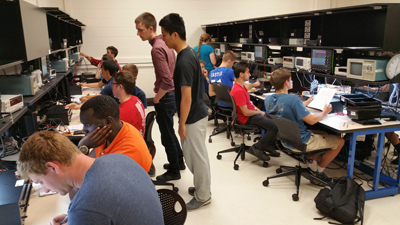
Bernstein created a Sophomore-level, 3-credit course, EE20225, Introduction to Electrical Engineering, which he taught from 2015 to 2024. The course comprised two lecture and one 3-hour laboratory per week. The activities include such topics as an introduction to electrical circuit analysis, electronic materials; electronic measurement equipment; 3-phase power and the power grid; filters, Fourier and frequency domain; radio transmission and amplitude modulation; semiconductor devices; lighting technology and solar cells; analog-to-digital, digital-to-analog conversion, and the Nyquist criterion; and batteries and power supplies.
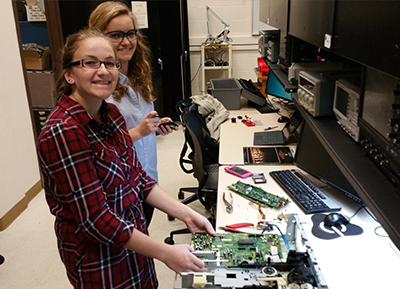
In the area of graduate education, Bernstein has innovated several specialized courses intended specifically to help graduate students in their laboratory research by covering the areas of scanning electron microscopy, vacuum technology, and various imaging methods for nanotechnology.
Bernstein has directed many undergraduate projects over his career. Most recently, students under his direction have written and published journal papers resulting from their efforts, and they have gone on to excellent graduate schools.
- J. Yang, E. C. Kinzel, S. M White, A. O. Orlov, W. Porod, G. H. Bernstein, G. P. Szakmany, "Linear Polarization Effect of Spiral Antennas for Long Wave IR Detection" to appear in IEEE Sensors Journal.
- C. P. Finnan, E. C. Kinzel, G. P. Szakmany, A. O. Orlov, H. R. O. Aquino, W. Porod, G. H. Bernstein, “Performance of Ultrafast, Nanoantenna-Based, Long-Wave Infrared Detectors in Vacuum,” IEEE Sensors Journal doi: 10.1109/JSEN.2024.3350384 (2024).